
Black beard algae
Dark gray to black tufts on leaf edges, wood and equipment.
Short, dark tufts like a brush, firmly attached to the edges of slow-growing leaves, driftwood, rocks, filter pipes and hoses. A drop of rubbing alcohol on a removed tuft turns it red, because it is a red alga.
- Main cause
- Unstable or low CO₂ while the lights are on: levels that swing up and down, or run short during the lit hours
- First fix
- Cut off badly covered leaves and scrub or boil-rinse rocks and wood outside the tank.
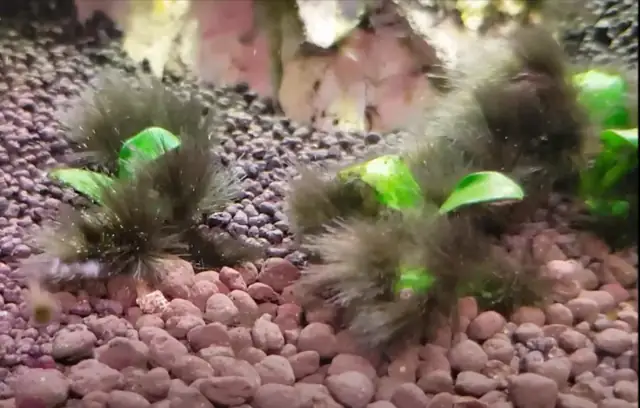
In a real tank: black beard algae on plants and gravel. Photo: Emboli, CC BY 3.0, via Wikimedia Commons

What causes it
- Unstable or low CO₂ while the lights are on: levels that swing up and down, or run short during the lit hours
- Strong light over slow-growing plants
- Old, organically loaded water and a dirty filter
How to remove it today
- Cut off badly covered leaves and scrub or boil-rinse rocks and wood outside the tank.
- Siphon out loose tufts and clean the filter in tank water.
- Keepers report less black beard algae when they dose a liquid carbon product, but these are not sold as algae killers. Dose for your tank volume as the label says; the maker of Flourish Excel warns that squirting it onto plants or overdosing can damage them, and anacharis and vallisneria can be sensitive.
How to stop it coming back
- Keep CO₂ steady through the lit hours, or do without injected CO₂. A solenoid on a timer that switches CO₂ on before the lights and off before they go out, at the same times every day, is fine.
- Try a shorter light period, such as 6 to 8 hours, and add faster-growing plants.
- Keep up weekly water changes and filter cleaning.
Fish and invertebrates that eat it
They keep it down once the cause is fixed; none of them clears a bloom on its own.