

Getting a pair
Cichlids choose their own partners. The surest way to a pair is to raise five or six young fish together and let two of them pair off, then rehome the rest; a pair is easy to spot, because they stay together and chase the others from their corner. Males are usually larger with longer, more pointed fins; in kribensis the female is the smaller, rounder one with the bright red belly, and in rams the female shows a pink belly before spawning.
Where each one spawns
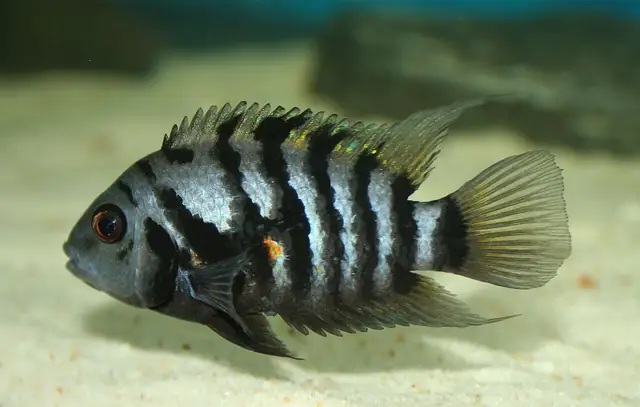
- Convict cichlids pair and breed from about six months old, sometimes earlier. The female sticks the eggs inside a cave or under a stone. A pair needs a 20 gallon or larger tank to itself, and it will breed again and again; few stores want the fry, so plan before you start.
- Kribensis spawn inside a cave, such as a half flower pot laid on its side, and the female guards the eggs while the male patrols outside. In the wild a male sometimes keeps more than one female.
- Rams pair before spawning and lay 150 to 300 small sticky eggs on a flat stone or in a pit dug in the gravel; both parents tend them. They need warm, clean, soft water to breed, and young pairs often eat their first clutches.
- Angelfish clean and lay on a vertical surface: a broad leaf, a slate leaned against the glass, the heater or the filter intake. A spawning slate makes it easy to move the eggs if the parents keep eating them.
Eggs, wrigglers and free-swimming fry
In convicts the eggs hatch in about three days, and the young spend about three more days as wrigglers living on their yolk before they swim. The parents fan the eggs with their fins, chase off anything that comes near and, once the fry swim, lead them around the tank as a cloud and gather them back to the nest at night. Brood care lasts several weeks.
Feed the fry baby brine shrimp, microworms or crushed fry food several times a day once they swim; the parents often stir up food for them. Feeding fry
Tankmates while they breed
A breeding pair claims part of the tank and attacks anything that comes near, including fish twice its size, and convicts are more aggressive in warm water. In a community tank that can mean torn fins and fish hiding in the corners for weeks. Give the pair its own tank, or a large tank with enough rocks and plants that other fish can stay out of sight. Stress, an open tank or busy tankmates are the usual reasons a pair eats its eggs. Check tankmates