
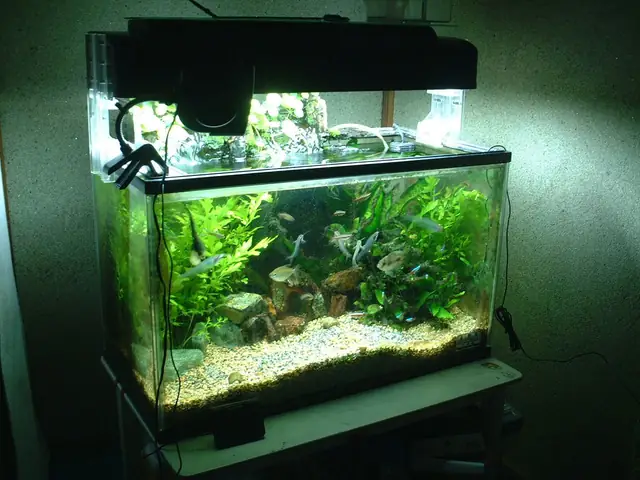

Choosing a stand
On a rimmed tank, the whole bottom frame must rest on the stand, level and flat; a rimless tank needs whatever flat top or mat its maker calls for. A stand that is merely wide enough, or a shelf rated for books, is not built for the load. Follow the tank maker’s support instructions, and do not remove braces, drill glass or add a mat unless that model’s instructions say you can.
The filled weight calculator adds water, tank, gravel, rock and equipment, then the stand, so you know the total the floor carries. For a large tank on an upper floor or in an old building, ask a structural engineer.
Choosing a lid
Buy the top the tank’s maker lists for your exact tank. Aqueon’s Hinged Glass Tops come in versions made for particular tanks, and our six Aqueon tank plans name the one that fits each; another tank with the same gallon label can have a different rim.
If you are matching a top yourself, measure the ledges it rests on and any center brace. A 4-foot tank usually takes two panels. The size printed on a product’s box is the box, not the lid.
Room for hoses, cords and the feeding door
- Mark at the rim where each filter intake and outlet, hose, airline and cord passes.
- Cut the top’s plastic back strip only where its instructions show; never cut the glass or a brace.
- Check the top still rests on its ledges with everything in place.
- Open the feeding door all the way, and make sure the whole top lifts off.
- Check where the light sits: many rest on the rim, not on the glass top. Stand a light on the glass only if its maker says the top can carry it. Light fit
Dry-fit it all before you fill. If a light’s bracket takes the ledge the lid needs, choose a light with a different mount.
Room to clean the filter
A canister needs hose routing and space to remove media. A HOB needs rear clearance and space above its basket. Use the cabinet-clearance guide before filling, then follow the setup sequence.