
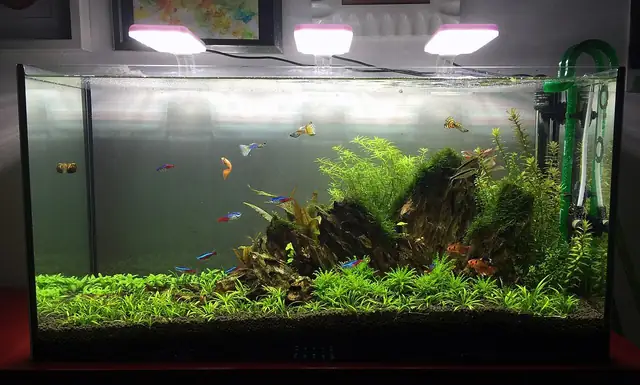

Check the mounting span
Measure the outside length of the rim where the light’s legs or brackets will rest, and compare it with the fixture’s published range. Gallons do not tell you this: a 20 high and a 20 long hold the same water but are about 24 and 30 inches long. A clip-on light instead needs a rim edge its clamp can grip and a spot that clears the lid.
Leave a gap for feeding and for opening the lid, and plan where the cable and controller will hang. Check the lid ledge, brace and rear openings before choosing a mount.
Once the light fits, match its output to your plants: the low-tech planted tank guide covers easy plants under a modest light, and the planted equipment checklist covers the rest of the setup.
Check the exact generation and size
Fluval Plant 4.0 and Plant 3.0 are separate generations, with different item numbers and features. Our light pages list them separately, and a listing photo of one does not tell you which you are buying: check the item number.
Sizes in the same family differ too, in power, mounting range and output, so pick the size for your tank’s length before you compare anything else.
Watts don’t measure light for plants
Watts tell you what a light costs to run, not how much light reaches the plants. For that, makers publish PAR, the light plants can use, measured at a given depth. Compare PAR figures only when they were measured at the same depth, and expect less at your substrate if your tank is deeper than the maker’s measurement. Low-light plants such as java fern and anubias need little; carpets and red stem plants need a lot. Fluval publishes PAR at several depths for every Plant 3.0 and 4.0 size, so for those you can check the light at your tank’s depth. Red plants and light
App, controller and timer
Some lights are set up through a phone app over Bluetooth, others with a remote or buttons on the fixture. Before you buy, check whether the light works without the app, and whether it keeps its schedule after a power cut or starts again at full brightness.
For how many hours to run it, see how long to leave the light on. The electricity cost calculator turns those hours into a cost.
What an IP rating means
An IP rating says how well a fixture is sealed against dust and water: IP67, for example, survives a short dip. It does not make the light safe to run under water unless the manual says so, and it rarely covers the power supply, which stays dry and above the floor like any other plug. Plugs and drip loops
Before you buy: the mounting range against your rim, the generation and size, whether you need the app, and the PAR at a depth close to your tank’s.