
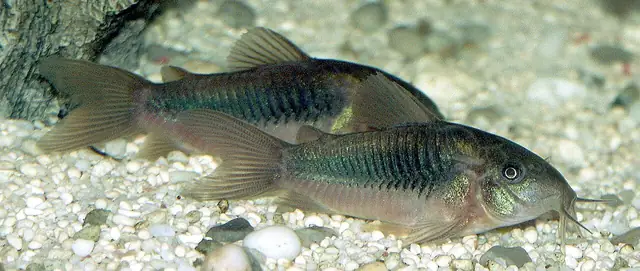

The group and the tank
Keep a group of six or more, with about two males for every female. Females are larger and rounder, especially seen from above; males are smaller and slimmer. Bronze, peppered and panda corydoras are among the easiest to breed; bronze corydoras are bred in large numbers for the trade. Feed the group well for a week or two with sinking pellets and live or frozen food, such as bloodworms or brine shrimp, to bring the females into condition.
What sets them off
In the wild they breed when the rainy season changes the water. A large water change, about half the tank, with water a few degrees cooler than the tank, often has the same effect the next morning, especially when the air pressure is falling before a storm. If nothing happens, repeat it every day or two for a week.
You will see the males chasing a female across the glass, then the pair in the T-position: the male across the female’s head. She then swims off with a few eggs held between her pelvic fins, cleans a spot on the glass, a leaf or the filter sponge, and presses them on.
Saving the eggs
The adults, and most tankmates, eat the eggs. Either move the adults out once spawning ends, or move the eggs: roll them gently off the glass with a fingertip into a small container of tank water, then into a breeder box or a small tank with an air stone. Eggs that turn white within a day or two were not fertilized or have fungus; remove them so the fungus does not spread to the good ones.
The eggs hatch in about three to five days at tropical temperatures. The fry live off their yolk sac for the first two or three days.
Feeding the fry
Once the fry swim and the yolk is gone, feed microworms, baby brine shrimp or crushed fry food, a little several times a day. Cory fry feed on the bottom, so a bare bottom or a thin layer of fine sand keeps food where they can find it and makes cleaning easy. Change a little water every day or two; cory fry are sensitive to dirty water. Microworm cultures · Hatching brine shrimp · Raising fry