
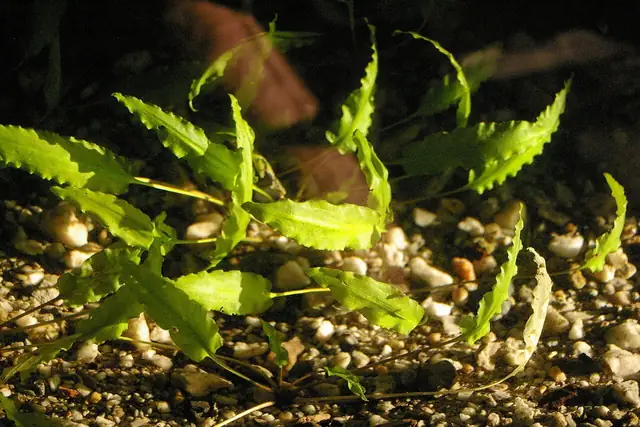

What emersed and submersed mean
An emersed plant grows with its roots wet and its leaves in the air; a submersed plant grows entirely under water. Many aquarium plants grow both ways in the wild. Crypts, for one, live in forest pools and on riverbanks that are under water only when the river is high, and they flower above water. Such plants grow a different leaf for each life: a plant that grows two kinds of leaves is called heterophyllous, and many water plants do it in response to their tips reaching the air.
How to tell which you bought
- Emersed: thick, stiff, often rounder leaves that stand up on their own out of the water; sometimes flowers. Plants in a pot with rock wool and plants in a tissue-culture cup are usually grown this way.
- Submersed: thinner, softer leaves that go limp in the air, and stem plants with narrower leaves. Bunches and cuttings from a store’s display tank or another keeper’s aquarium are usually grown under water.
What happens after you plant it
The plant switches over. Old emersed leaves yellow, turn see-through and rot while new underwater leaves come in; stem plants drop their lower leaves and grow narrower ones above. Crypts can lose every leaf, which is so common it has a name, crypt melt, and they regrow from the roots. Java fern and anubias change little; anubias can even be grown above water.
- Leave the roots and rhizome where they are and do not dig the plant up to check.
- Cut rotting leaves off at the base so they do not foul the water.
- Give the new leaves light, 6 to 8 hours a day to start, and push a root tab in beside crypts and swords.
- Expect new growth within a few weeks, slower for crypts and anubias.
Growing plants emersed on purpose
- Dry start: grow a carpet in damp substrate under a lid, then flood the tank once it has rooted. The dry start method
- Paludarium or riparium: a tank that is part land and part water, or one with plants in pots at the back growing up out of the water.
- Plants over an open top: anubias, crypts and many stem plants grow leaves above the waterline in an open tank, and pothos grows from the rim with only its roots in the water.
- Keep the air humid: emersed leaves dry out in room air, so a dry start or a young emersed plant needs a lid or wrap over it until it is established.