
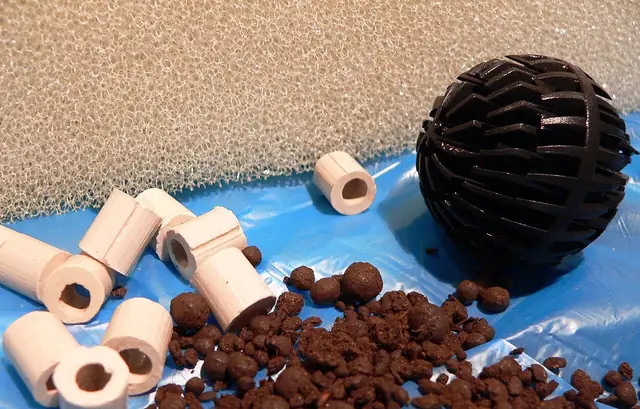

Mechanical media traps particles
Coarse sponge goes first, where the water comes in, and catches the larger dirt; fine floss or pads after it polish the water. Fine pads clog fastest and slow the flow as they fill, so they are the part you rinse or replace most often.
A cartridge often combines floss and carbon in one piece, so throwing it away removes both. Our filter pages list what comes with each filter: check them before you order spares.
Biological media holds the bacteria
Sponge, ceramic rings and other porous media give the bacteria that turn ammonia into nitrate somewhere to live. New media from the box has none yet; it takes weeks of running to grow them. Cycling a new tank
This is the media you keep. Rinse it in old tank water when it clogs, never under the tap, and never replace all of it at once, or the tank has to cycle again. A sponge does both jobs at once: it catches dirt and holds bacteria.
Chemical media: carbon and others
Activated carbon takes out tint from driftwood, smells and leftover medicine; other chemical media remove one thing each, such as phosphate or ammonia. None of them replaces a sponge or a working biofilter, and most tanks run well without any. Use them for a problem you have, and follow the label for how much and how long it lasts; carbon cannot be cleaned and is used up in a few weeks.
Take carbon out while you treat sick fish, since it removes many medicines; the medicine’s label says whether to. And do not stuff every empty space in the basket: packed media forces the water around it instead of through it.
Which order do they go in?
Canisters, hang-on-back baskets and cartridge filters route water differently, so the order depends on the filter. In a Tidal 35, water enters the basket at the bottom and leaves at the top, and Seachem’s media-order answer puts the sponge at the bottom, chemical media in the middle and biological media such as Matrix on top. The Fluval 107 and 307 arrive loaded, and the 07 Series manual asks you to put each medium back at the basket level it was packed in.
For any other filter: find where the water comes in, put the sponge or coarse pad there, and follow the maker’s order for the rest. Keep a photo of the basket as it arrived; it is the easiest way to get it back right.
Check the filter after restarting it
Restart the filter as in the filter maintenance guide and watch the flow for a few minutes. If it is weaker than before, a pad is in the wrong place or packed too tight. Leaks, noise or low flow that stay after that are a problem with the filter, not the media, and new media will not fix them. Troubleshooting by symptom