
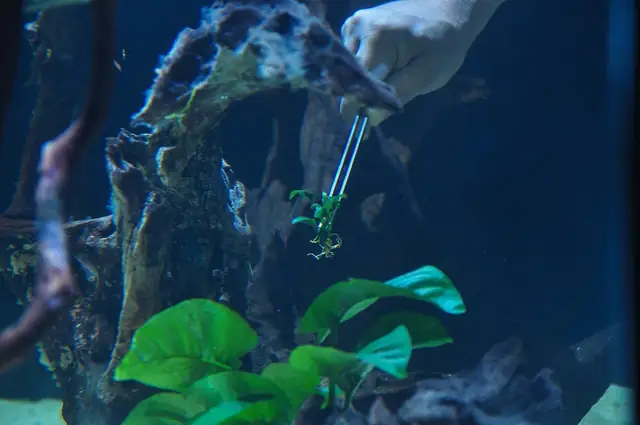

Liquid, root tabs or both
Look at where your plants take their food. Java fern, anubias and mosses grow on wood or rock with no roots in the substrate, and floating plants hang their roots in the water: both live on what is dissolved in it, so a liquid suits them. Amazon swords, crypts, vallisneria and lilies grow big roots and feed mostly through them; in plain gravel or sand they need root tabs. Stem plants take from both. A tank with a mix of plants usually uses both, and a nutrient-rich planted substrate does the root tabs’ job for its first months.
How much liquid fertilizer
Each maker prints its dose per volume of water, and the products are not the same strength, so a dose from one bottle means nothing for another:
| Fertilizer | Label dose | How often |
|---|---|---|
| API Leaf Zone | 5 mL per 10 US gal | Once a week |
| Easy Green (Aquarium Co-Op) | 1 mL per 10 US gal | Once a week in low light, twice in medium, three times in high |
| Seachem Flourish | 5 mL per 60 US gal (250 L) | Once or twice a week |
| Tropica Premium Nutrition | 6 mL per 50 L (3 pumps) | Once a week |
For a 20 gallon that is 10 mL of Leaf Zone a week, 2 to 6 mL of Easy Green depending on the light, 1.7 mL of Flourish once or twice, or about 4½ pumps of Tropica. Add it after the weekly water change, when the fresh water has diluted what was left. Work out your tank’s dose
How many root tabs, and how often
Push each tab well down, at least an inch or about halfway into the gravel, so it releases into the roots and not the water. Put the first ones right under the heavy feeders and spread out as their roots grow.
- Seachem Flourish Tabs: one for each 4 to 6 inch radius of gravel; a standard 10 gallon takes 6. Replace every 3 to 4 months.
- API Root Tabs: one for every 30 square inches of gravel; also 6 in a standard 10 gallon. Replace monthly.
- Easy Root Tabs: one every 4 to 6 inches in a grid. Replace monthly, or as the plants use them up.
You do not need a full grid if only a few plants root deeply: two or three tabs around each sword or crypt clump do the work.
Feed to the light, not just the gallons
Light sets how fast plants grow, and growth sets how much food they use. A low-tech tank with a basic light and slow plants uses less than the label’s full dose; fish waste already supplies some nitrogen and phosphorus. A tank with a strong light and injected CO₂ uses the full dose or more. That is why Easy Green’s label doubles the weekly doses for medium light and triples them for high light. If you change the light or its hours, change the fertilizer with it. How long to run the light
Too little or too much
Too little shows in the new growth and the old leaves first:
- Old leaves yellowing from the tip: often nitrogen or potassium.
- New leaves pale or white: often iron.
- Pinholes in older leaves: often potassium.
Melting right after planting is usually the switch from farm-grown to underwater leaves, not a deficiency. Plant melt · Read the leaves
Too much shows as algae on the glass and leaves while the plants grow no faster. With an all-in-one that carries nitrogen, a nitrate test tells you: nitrate climbing past 40 ppm between water changes means more goes in than the plants take out. Cut the dose, not the water changes. Change one thing at a time and give it two or three weeks before you judge it.
Fertilizer in a shrimp tank
Shrimp and snails are sensitive to copper, which most fertilizers carry in trace amounts because plants need it. At the label dose that is fine; Seachem says Flourish is safe with shrimp. Overdosing is where the risk starts, so in a shrimp tank keep to the label dose or below it, and dose after the water change rather than all at once on a big top-up. Plants for a shrimp tank